Democratizing User Interfaces
In this dissertation, we investigated how to democratize graphical user interfaces (UIs) through personalization. Drawing on democratic principles rooted in freedom and equality, with power distributed and individuals participating in decision-making, we explored a shift from static, developer-controlled interfaces toward a more democratized process in which individuals can exercise control over the design of the UIs they use.
User interfaces are key intermediaries for accessing public services, information, and entertainment. Nevertheless, most UIs follow a one-size-fits-all approach, which limits their experience in contexts or by users not considered during design. UI personalization seeks to bridge this gap by aligning standardized layouts with individual preferences, enhancing efficiency, usability, and accessibility. While some systems allow superficial adaptations (e.g., color modes and font sizes), these are often misaligned with users' actual needs and preferences. Conversely, more open-ended approaches (e.g., code injection) demand significant effort and expertise, placing them beyond the reach of most users.
This dissertation investigates the democratization of UIs, which results from empowering users to meaningfully reimagine and redesign the interfaces they use in daily life. Democratization extends beyond simply providing personalization options; it requires creating conditions where all users (not only experts) can exercise agency over their interfaces. This involves reducing the effort required for implementation and supporting users in identifying personalization opportunities that are both significant and beneficial.
To address this challenge, we placed users at the center of our research. Across four studies, participants were invited to share their perspectives, supported in identifying and enacting interface changes, and encouraged to reflect on how personalization tools and UIs should be designed. Specifically, we examined how community-based mechanisms can support personalization implementation and how access to interaction data can facilitate ideation.
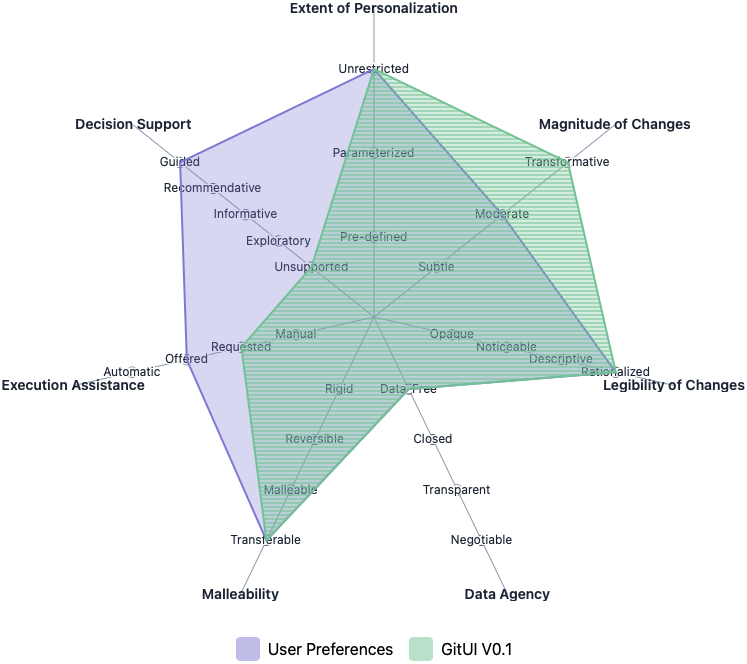
This work makes several contributions, including: (1) an in-depth account of user needs, practices, and challenges in personalization; (2) the concept of community-based personalization as a way to adapt, share, and reuse interface customizations; (3) design considerations for leveraging interaction data to guide users toward meaningful personalization; and (4) a design space for end-user UI personalization to inform future research and practice.
Authors: Sérgio Alves
Venue: Universidade de Lisboa
Related Projects:
Related Software: